Do you need to create Support Analyst SOPs but don’t know where to start? We’ve created thousands of SOPs tailored to your unique business needs, including tips & best-practice procedures that save you hours of research, writing, and formatting. Trusted by some of the world’s leading companies, these scalable Notion SOPs will help you jumpstart your SOP creation process as a Support Analyst.


Example SOPs: Support Analyst
Support Analyst SOPs
Creating Standard Operating Procedures for your Support Analyst work can be difficult and take time. That’s why we’ve created these example Support Analyst SOPs so you can jumpstart your SOP creation process. We want to help you set up your IT systems and processes by taking these sample SOPs and building out your own SOPs template library. By having all your IT procedures in one place, your team will have the information they need at all times. Let’s look at some Support Analyst SOP examples.
Support Analyst SOP Examples
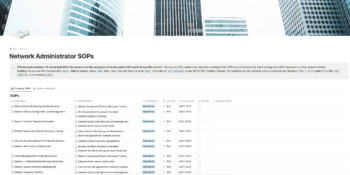
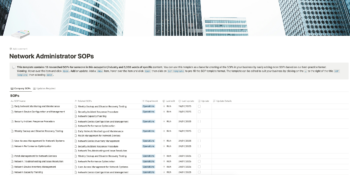
1. Incident Management SOP: The purpose of this SOP is to outline the process for managing and resolving incidents reported by users. It includes steps for incident identification, logging, categorization, prioritization, investigation, resolution, and closure. The scope of this SOP covers all incidents reported within the organization’s IT infrastructure. The Support Analyst is responsible for following this SOP, and it references the Change Management SOP for any necessary changes to the system.

2. Problem Management SOP: This SOP aims to establish a systematic approach to identifying, analyzing, and resolving recurring incidents or underlying problems. It includes steps for problem identification, logging, categorization, prioritization, investigation, root cause analysis, and implementing permanent solutions. The scope of this SOP covers all recurring incidents or problems within the organization’s IT infrastructure. The Support Analyst is responsible for following this SOP, and it references the Incident Management SOP for incident-related information.
3. Change Management SOP: The purpose of this SOP is to define the process for managing changes to the organization’s IT infrastructure. It includes steps for change request submission, assessment, approval, implementation, and post-implementation review. The scope of this SOP covers all changes to hardware, software, configurations, or processes within the IT infrastructure. The Support Analyst may be involved in change request submission or implementation, but the Change Manager is primarily responsible for this SOP. It references the Incident Management SOP for any incidents related to changes.
4. Asset Management SOP: This SOP outlines the procedures for managing and tracking the organization’s IT assets, including hardware, software, and licenses. It includes steps for asset procurement, inventory management, tracking, disposal, and license compliance. The scope of this SOP covers all IT assets owned or used by the organization. The Support Analyst is responsible for following this SOP, and it may reference the Incident Management SOP for incidents related to asset management.
5. User Support SOP: The purpose of this SOP is to provide guidelines for providing technical support to end-users. It includes steps for incident triage, troubleshooting, resolution, and user communication. The scope of this SOP covers all user support requests within the organization. The Support Analyst is responsible for following this SOP, and it may reference the Incident Management SOP for incident-related information.
6. Knowledge Management SOP: This SOP aims to establish a process for capturing, organizing, and sharing knowledge within the organization. It includes steps for knowledge creation, documentation, storage, retrieval, and continuous improvement. The scope of this SOP covers all knowledge related to IT support and troubleshooting. The Support Analyst is responsible for following this SOP, and it may reference the User Support SOP for user-specific knowledge.
7. Security Incident Management SOP: The purpose of this SOP is to outline the process for managing and responding to security incidents within the organization’s IT infrastructure. It includes steps for incident identification, containment, eradication, recovery, and post-incident analysis. The scope of this SOP covers all security incidents, including breaches, malware attacks, or unauthorized access attempts. The Support Analyst may be involved in incident identification or containment, but the Security Analyst or IT Security Manager is primarily responsible for this SOP. It may reference the Incident Management SOP for incident-related information.
8. Backup and Recovery SOP: This SOP defines the procedures for backing up critical data and systems, as well as the process for recovering data in case of a failure or disaster. It includes steps for backup scheduling, storage, verification, and restoration. The scope of this SOP covers all critical data and systems within the organization’s IT infrastructure. The Support Analyst may be responsible for executing backups or assisting in data recovery, but the Backup Administrator or IT Operations Manager is primarily responsible for this SOP. It may reference the Incident Management SOP for incidents related to data loss or system failures
Support Analyst SOP Templates
Looking for SOP templates for your Support Analyst work? We’ve got you covered. You can build out your company SOPs using the sample SOP information above (added to our template) or our team can put together a starter SOPs template based on your Support Analyst work. Get in touch if you’ve got questions about the quickest way to build out your IT SOPs library.
Related products

Updating…